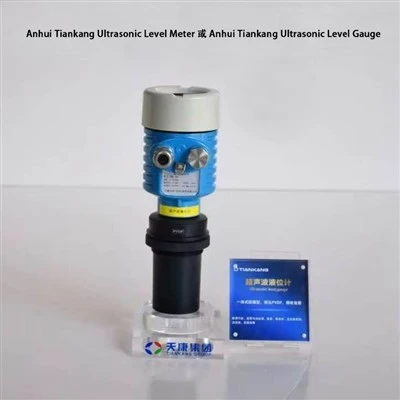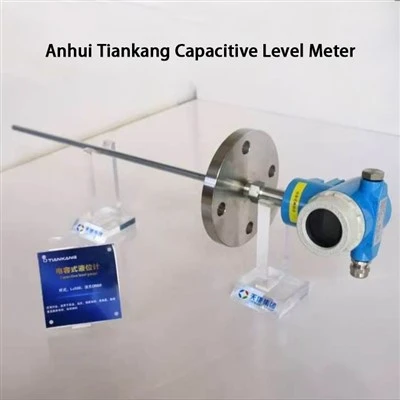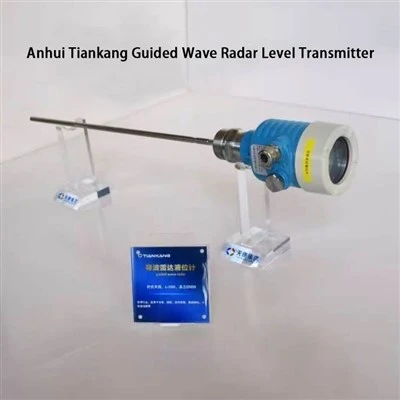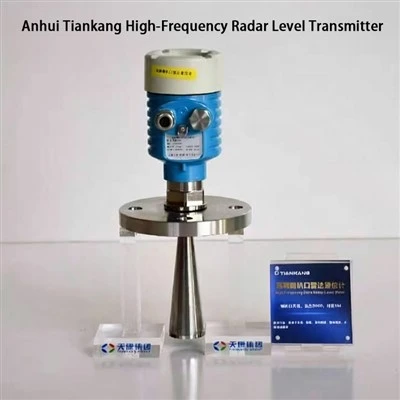


We supply a Guided-wave radar level meter for continuous level measurement in industrial tanks, process vessels, storage containers and powder silos. It is commonly used in petroleum refining, chemical processing, power generation and other industries where stable level monitoring is required. The instrument is suitable for measuring liquids and certain bulk solids, including applications involving foam, vapor, dust or internal tank obstructions.
We offer rod-type, cable-type and coaxial-tube designs to suit different vessel structures and measuring conditions. By transmitting microwave pulses along a probe, the instrument measures the distance to the material surface through reflected signals. This measuring principle reduces the influence of foam, vapor, dust and equipment inside the vessel. Different probe materials and connection options are available to help match the instrument to the measured medium and installation environment.
Core Advantages
Stable Measurement: Microwave signals travel along the probe, reducing interference from foam, vapor, dust and internal tank structures.
Multiple Probe Designs: Rod, cable and coaxial tube options cover different measuring ranges and vessel configurations.
Low Dielectric Constant Measurement: Suitable for selected low-dielectric media, including light oils and liquefied gas.
High Temperature and Pressure Options: Configurations are available for demanding industrial process conditions.
Flexible Signal Output: Supports 4–20 mA HART, RS485 and relay alarm functions.
Corrosion-Resistant Materials: Optional PTFE coating and Hastelloy components are available for corrosive media.


Applications
- Crude oil and petroleum storage tanks.
- Chemical processing tanks and reactors.
- High-temperature and high-pressure vessels.
- Liquefied gas storage systems.
- Industrial powder and bulk material silos.
- Power generation and process monitoring systems.
OEM/ODM Customization
We can supply a Guided-wave radar level meter according to customer requirements. Customization options include probe length, rod or cable structure, probe material, corrosion-resistant coating, process connection, pressure rating, signal output and explosion protection configuration. We can also match the instrument to the tank dimensions and installation conditions provided by the customer.


Quality Control
We inspect the instrument structure, probe assembly, electrical connections and measurement performance before delivery. Each unit is supplied with a factory test report. CE, ATEX and IECEx documentation and ISO/IEC 17025 calibration reports can be provided according to the selected product configuration and certification requirements.
Product Specifications
|
Parameter |
Specification |
|
Product Type |
Guided-wave radar level meter |
|
Series |
TWR |
|
Probe Types |
Rod / Cable / Coaxial Tube |
|
Measuring Range |
0–6 m / 0–35 m / 0–10 m |
|
Probe Material |
316L Stainless Steel |
|
Optional Probe Coating |
PTFE / Hastelloy |
|
Measuring Accuracy |
±1–3 mm |
|
Medium Temperature |
-40°C to +250°C, up to +300°C for high-temperature models |
|
Pressure Rating |
PN16 / PN40, higher pressure available on request |
|
Dielectric Constant |
ε ≥ 1.5 |
|
Output Signals |
4–20 mA HART / RS485 / Relay Alarm |
|
Explosion Protection |
Ex d IIC T6 |
|
Protection Rating |
IP67 Transmitter / IP68 Probe |
|
Process Connection |
M20×1.5 Thread / Flange |
|
Standard |
JB/T 10638 |
|
Warranty |
18 Months |
FAQ
Q: What is the difference between rod-type and cable-type guided wave radar?
A: Rod-type probes are generally used for shorter measuring ranges and vessels with limited installation space. Cable-type probes are suitable for deeper tanks, tall vessels and silos requiring longer measuring ranges.
Q: Can a guided wave radar level meter measure media with foam or vapor?
A: Yes. Since microwave pulses travel along the probe rather than through the tank atmosphere, foam and vapor generally have less influence on measurement than they do on ultrasonic level meters.
Q: Is guided wave radar suitable for highly viscous or sticky media?
A: Not always. Media that strongly adhere to the probe may cause buildup and weaken the reflected signal. We recommend evaluating the medium and operating conditions before selecting a probe.
Hot Tags: a guided-wave radar level meter, China a guided-wave radar level meter manufacturers, suppliers, factory, level control system, level sensing instrument, level switches, multifunction measuring instrument, process level transmitter, resistance meter