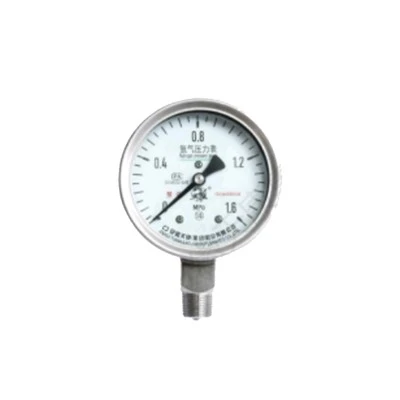
In 1843, French scientist Lucien Vidi invented and manufactured the aneroid barometer, which utilized the extension of a spring to measure atmospheric pressure. In 1849, Eugène Bourdon obtained a patent for the Bourdon tube pressure gauge. In 1930, Walter Gref invented the first sensor mechanism capable of converting mechanical pressure displacement into an electrical signal. In 1965, Statham introduced a thin-film transducer characterized by high stability and low hysteresis, marking a significant technological advancement in high-pressure measurement. In 1967, Art R. Zias and John Egan filed a patent for the edge-constrained silicon diaphragm, ushering in a new era of sensor technology; in 1969, Hans W. Keller filed a patent for mass-produced silicon sensors. In 1973, William R. Polye filed a patent for glass or quartz capacitive sensors; in 1979, Bob Bell of Kavlico applied this technology to ceramic substrates, filling a gap in low-pressure measurement capabilities. In 1994, the Japanese company Yokogawa invented single-crystal silicon resonant sensor technology. By 2000, piezoresistive technology had become one of the most prevalent pressure sensor technologies, suitable for a wide range of pressures and measurement modes.