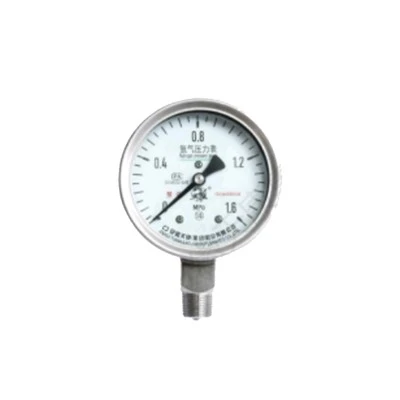
The basic operating principle of mechanical pressure instruments (such as the common Bourdon tube pressure gauge) involves the use of elastic sensing elements (e.g., spring tubes, diaphragms, capsules, or bellows) that undergo elastic deformation under the influence of pressure. This deformation is amplified by a transmission mechanism-typically comprising connecting rods and gears-to drive a pointer that indicates the corresponding pressure value on a scale.
The vibrating-wire pore water pressure gauge is a type of electronic pressure gauge; its structure primarily consists of a metal housing, a porous filter stone, a sensor (the core component), and a signal cable. During operation, pressurized water passes through the porous stone into the pressure chamber and acts upon a pressure-sensitive diaphragm, causing it to flex. This deflection alters the stress on an attached steel wire, thereby changing the wire's natural resonant frequency. By measuring this frequency shift and applying the formula P = K(fo² - fi²)-where P is the pore water pressure, K is the calibration coefficient, fo is the initial frequency, and fi is the measured frequency-the pressure value can be calculated.
A piston-type pressure gauge is a precision device used for measuring or generating pressure based on the principle of force balance. Its core operating principle involves external pressure acting on the effective area of a piston to generate an upward force, which is balanced by the downward gravitational force of standard weights applied to the system. When the piston reaches a state of suspension (equilibrium), the system pressure can be calculated using the force balance formula P = F/S (where P is pressure, F is the weight force, and S is the effective area of the piston). Modern piston gauges often employ displacement sensors to monitor the piston's minute displacements or operational state, converting this information into electrical signals for control and readout purposes.