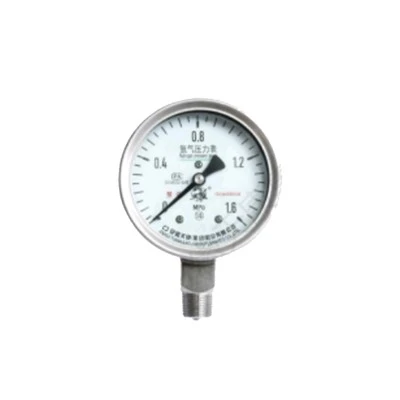
Key specifications for pressure gauges include measurement range, accuracy class, dial diameter, connection type, and medium temperature range. The measurement range refers to the minimum and maximum pressure values the gauge can measure (e.g., 0–1 MPa, 0–10 MPa). Accuracy class indicates the margin of measurement error; common classes include 1.0, 1.6, and 2.5. Dial diameter refers to the size of the gauge housing; common sizes are 40 mm, 60 mm, and 100 mm. Connection types include threaded connections, such as M20×1.5 or G1/4. The medium temperature range is typically -20°C to +60°C, though special materials can withstand high temperatures up to 300°C.
Selection Criteria for Different Applications
For industrial high-pressure environments, select products with a wide measurement range, high accuracy, and stainless steel construction. Precision laboratory measurements require high-accuracy gauges (Class 0.4 or 0.25). The food and pharmaceutical industries require sanitary-grade pressure gauges made of 316L stainless steel.
Principles for Selecting Measurement Range
The selected range should be slightly higher than the actual operating pressure. When measuring steady pressure, the maximum operating pressure should not exceed two-thirds of the full scale; for pulsating pressure, it should not exceed one-half; and for high-pressure applications, it should not exceed three-fifths of the upper limit. The minimum measured pressure should be no less than one-third of the full scale.
Principles for Selecting Accuracy Class
The maximum error of the selected pressure gauge must be less than the maximum absolute error permitted by the production process. Provided that process requirements are met, it is advisable to select instruments with lower accuracy-which are generally more cost-effective and durable-whenever possible.