According to the "Announcement of the Ministry of Housing and Urban-Rural Development on the Issuance of the National Standard 'Code for Electrical Design of Civil Buildings'" [2019 No. 314], the 'Code for Electrical Design of Civil Buildings' has been approved as a national standard, numbered GB 51348-2019, effective from 1 August 2020, and the previous industry standard 'Technical Code for Electrical Design of Civil Buildings' JGJ 16-2008 is simultaneously abolished. From an industry standard to a national standard, this updated standard makes many improvements in various aspects and will have a profound impact on the related industry, especially in fire protection for building wiring. To address the vague and inconvenient specifications of flame-retardant wires and cables in the previous JGJ 16-2008, the new national standard GB 51348-2019 clearly specifies the combustion performance levels for installing wires, cables, and optical fibres in different areas of civil buildings in Chapter 13 'Electrical Fire Protection in Buildings'. To help the cable industry understand the latest requirements and adapt their product development and testing certifications accordingly, this article summarises and introduces the relevant fire protection requirements for cables in the new building electrical design standard and CQC fire certification.
Fire safety requirements for cables in GB51348
For simplicity, this article mainly focuses on the fire performance rating requirements for cables.
By organising the relevant requirements of Article 13.8 'Selection and Installation of Cables' and Article 13.9 'Selection of Non-Fire Load Cables and Communication Cables' in the GB 51348-2019 fire protection section for building electrical systems, the flame performance requirements corresponding to building cables are summarised in Table 1, mainly including three categories of products: electrical wires and cables for fire protection distribution lines, electrical wires and cables for non-fire loads, and electrical wires, cables and optical fibres for structured cabling systems
Table 1 shows the fire resistance requirements for cables and optical fibres for different types of buildings and locations
| Category | Types of buildings and venues and their uses | Fire rating requirement |
| Wires and cables for fire protection circuits | The alarm bus of the fire automatic alarm system used in evacuation routes in crowded places | You should choose wires and cables with a B1 fire rating |
| Alarm bus in other places | You should choose wires and cables with a fire rating of at least B1 | |
| Non-fire load wires and cables | Public buildings taller than 100m | You should choose wires, cables, and Class A cables that have a fire performance of B1 or above, smoke toxicity of t0, and burning droplet/particle rating of d0 |
| Exposed wires and cables on the refuge floor | You should choose wires, cables, and A-grade cables with a fire performance of at least B1, smoke toxicity of T0, and burning drips/particles level of D0 | |
| Financial buildings in high-rise buildings, provincial power dispatch buildings, provincial (city) broadcast, television, telecommunications buildings and crowded public places | You should choose wires and cables that are B1 fire-resistant, t1 in smoke toxicity, and d1 in burning droplets/particles. | |
| Other types of public buildings | You should choose wires and cables with a burning performance of at least B2, smoke toxicity level T2, and burning droplets/particles level D2 | |
| Underground building where people stay for long periods | You should choose wires and cables with smoke toxicity level t0 and burning droplet/particle level d0 | |
| Communication cables and fibre optics for structured cabling systems |
Public buildings with a height of 100m or more Public buildings with a height less than 100m or equal to 50m and an area over 100,000m² Data above grade B |
Horizontal installation: communication cables or optical cables that meet the requirements of the horizontal burning test should be used Vertical laying: You should use communication cables or optical fibres of at least B1 rating |
| important public places | Horizontal installation: You should use communication cables or optical fibres that are at least B1, and it's better to use ones that meet the horizontal burning test requirements Vertical installation: You should use communication cables or optical fibres of at least B2 rating |
|
| other public places | For horizontal and vertical installation: it is recommended to use B2-grade communication cables or optical fibres | |
|
Note: B1, B2, and A grades are the fire performance classifications for cables and optical cables as specified in GB 31247-2014 'Introduction to Cable and Optical Cable Fire Performance'. The fire performance of cables chosen for horizontal and vertical wiring within a building should be consistent. |
||
As can be seen in the table, GB 51348-2019 clearly adopts the relevant fire performance classification requirements from GB 31247-2014 'Fire Performance Classification of Cables and Optical Cables', specifying the fire performance levels for laying cables in different types of buildings and locations, which provides good guidance and practicality for selecting flame-retardant cables in standard building electrical fire safety design.
GB 31247-2014 standard and CQC fire protection certification
To address the long-standing issue of the lack of flame-retardant grading standards in the cable industry and the incomplete assessment indicators in the existing flame-retardant standard system, the former Sichuan Fire Research Institute of the Ministry of Public Security led relevant units to develop the national mandatory standard GB 31247-2014 'Classification of Combustion Performance for Cables and Optical Cables', which was released on 5 December 2014 and officially implemented from 1 September 2015. Based on thorough research and verification tests, and in combination with the requirements of EN 13501-6:2014 and the actual grading needs for domestic cables and optical cables, GB 31247-2014 eventually established four grades: A1, B1, B2, and B3. The assessment dimensions include main grading indicators such as heat of combustion, flame spread, heat release, smoke production, and smoke density, as well as three additional grading indicators: burning droplets/particles, smoke toxicity, and corrosiveness. Overall, these assessment indicators can more accurately reflect the actual combustion characteristics of cables in fire conditions, making the evaluation of cable flame-retardant performance more scientific, reasonable, and practically useful.
To coordinate the grading standards for flame-retardant cables with promotion and related testing and certification work, the China Quality Certification Centre, together with the National Fireproof Building Materials Quality Supervision and Inspection Centre (NFTC), has been working closely from the drafting stage. They developed the CQC17-463416-2015 "Implementation Rules for Flame Performance Grading Certification of Cables for Construction Projects" to implement cable and optical fibre flame performance grading certification. Since 2015, they have held standard and certification promotion meetings in cities like Nanjing, Yixing, Guangzhou, Jinan, and Chengdu, actively promoting the adoption of the standards to relevant construction design units and building design codes, achieving good promotion results. This work also lays a foundation for domestic flame-retardant cable exports to align with the technical requirements of the CPR construction product regulations.
Considering the identification and selection requirements for cables of different flame retardant levels, the 2020 new implementation rules (CQC17-463416-2020) added naming regulations for flame retardant cables, introducing some new B1 and B2 flame retardant cable models, such as WDZB1-YJY and ZB2-BV, and issued the first batch of new CQC fire protection certificates to some leading cable companies including Jiangsu Shangshang, Wuxi Jiangnan, Jiangsu Zhongmei and Sichuan New Century.
The new CQC fire protection certification implementation rules cover various building wire products including power cables, wiring cables, control cables, computer cables, flexible cables, communication cables and optical cables. Products that pass the certification can carry the CQC fire protection certification mark shown in Figure 1, proving that the product meets the relevant requirements for each flame retardant level. With the promotion of flame retardant classification standards and certification, there are now multiple laboratories, including the National Fireproof Building Materials Quality Supervision and Inspection Centre, the National Wire and Cable Product Quality Supervision and Inspection Centre (Yixing) and Shanghai Lan Hui Testing Technology Co., Ltd. (ISTCW), that have the relevant recognition for this flame retardant classification certification.
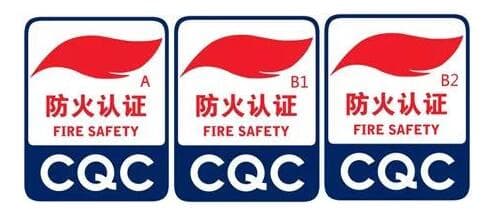
Figure 1 CQC fire protection certification marks for different combustion performance levels
3. Some misconceptions and future prospects of fire-resistant graded cables
In recent years, with the popular use of BT/T 19666 'General rules for flame-retardant and fire-resistant wires, cables or optical cables' and the flame-retardant categories ZA, ZB, ZC and ZD, there has been a common belief in the industry that the bundled flame-retardant ZA, ZB, ZC and ZD represent flame-retardant grades, and that Class A flame-retardant performance is better than (covers) Class B, C, and then D, due to the tendency to arrange the grades as A-B-C-D in common sense and the arrangement of non-metal content from high to low in testing.
However, standard analysis shows that the bundled flame-retardant categories (ZA, ZB, ZC, ZD) mainly differ in the applicable assessment scenarios, and the relevant standards do not mention grade relationships or classification concepts. In particular, in a recent article accepted by the journal Quality and Certification titled "Understanding and Suggestions on the Requirements for Bundled Flame-Retardant Wires", verification tests were conducted on typical wire products from different manufacturers: five sets each of ZA-BV450/750V 2.5 and WDZA-BYJ 450/750V 2.5. According to the GB/T 18380 series standards, these ten sets of samples underwent bundled Class A, B, C and D burning tests respectively. By analysing the carbonisation height after the burning tests, the results showed that for most bundled D-class conduction tests of these wire products, the carbonisation height was higher than that of the A-class tests, indicating D-class flame retardant failure. This bundled burning verification test of these wire products strongly demonstrates, from the perspective of actual test data, that the traditional bundled flame-retardant categories ZA, ZB, ZC and ZD do not represent flame retardant performance levels and there is no hierarchical relationship.
In comparison, GB 31247-2014 "Classification of Combustion Performance for Cables and Optical Cables" assesses and evaluates through multiple criteria, closely aligning with the actual fire safety requirements of buildings. It scientifically and systematically classifies the combustion performance of cables used in construction projects and provides clear explanations of performance levels in the standard, such as B1 combustion performance and flame-retardant level 2 cables (optical cables), B2 combustion performance and flame-retardant level 2 cables (optical cables), and so on. This also lays a solid foundation for the reference and adoption of GB 31247-2014's flame-retardant classification in GB51348 "Code for Electrical Design of Civil Buildings".
I believe that with the introduction and significant implementation of GB 51348 'Code for Electrical Design of Civil Buildings' and subsequent related design standards, all parties involved, from users, design units, supervision units, testing and certification agencies to manufacturers, will develop a more unified and clear understanding and application regarding the fire performance classification of cables and optical fibres. The development prospects for various flame-retardant cables and optical fibres used in domestic construction projects will also become brighter.